
'The market will focus on the fact that India does have strong earnings growth this year.'

'The market won't wait for earnings to recover.'

Equity indices staged a pullback on Tuesday after three days of declines as investors scooped up IT, metal and consumption stocks amid a largely positive trend overseas. A recovery in the rupee added to the momentum, traders said. Overcoming a wobbly start, the 30-share BSE Sensex climbed 274.12 points or 0.45 per cent to settle at 61,418.96.

It may be a little early to cheer the recovery in the fast-moving consumer goods (FMCG) space as a deceleration in discretionary demand, after the festival season, may offset fragile rural recovery, analysts have cautioned. "The overall demand environment for staples remains muted, while discretionary demand trends have seen some deceleration after the festival season. "We believe margins in staples have bottomed out, but we expect only a gradual uptick with the ongoing softening in raw material prices.

Bajaj Finance was the top gainer in the Sensex pack, climbing over 5 per cent, followed by Kotak Bank, SBI, PowerGrid, Axis Bank, HDFC Bank and Reliance Industries. On the other hand, HUL, Bharti Airtel, TCS, ONGC and Maruti were among the laggards.

Asian Paints was the top laggard in the Sensex pack, falling around 5 per cent, followed by Bajaj Finance, HDFC, IndusInd Bank, Axis Bank and Kotak Bank. On the other hand, Tech Mahindra, Sun Pharma, Bharti Airtel and HCL Tech were among the gainers.
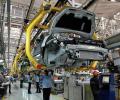
The K-shaped economic recovery in India from the pandemic slowdown shows in corporate results as well. The automobile sector, which represents big-ticket consumption, continues to do well and has increased its share in corporate revenues and profits while fast-moving consumer goods (FMCG) companies that sell low-ticket consumer goods are struggling with poor sales and earnings growth. The share of the automobile sector, including makers of auto ancillaries, in corporate net sales rose to a 10-quarter high of 10.05 per cent during July-September 2023 (Q2FY24) from 8.94 per cent a year earlier and 9.75 per cent in Q1FY24.

Of these 26, Bajaj Finance, Associated Alcohols and Breweries, Garware Technologies, Filatex India, Tasty Bite Eatables, Aarti Industries and GMM Pfaudler saw an over 10-fold surge in price since 2014.

The Street was hoping that investors will lap up shares of high-dividend companies on optimism that their payouts will increase further, thanks to the 20 per cent tax saving. However, the trade failed to materialise as wealthy investors stayed away fearing high tax outgo, and experts raised doubts on whether companies would actually increase cash dole outs.

Benchmark indices advanced for the second straight session on Tuesday, with the Sensex and Nifty jumping nearly 2 per cent each, mirroring a rally in global equity markets. Buying in index majors Reliance Industries and IT stocks buoyed the benchmarks. The BSE Sensex zoomed 934.23 points or 1.81 per cent to settle at 52,532.07. During the day, it rallied 1,201.56 points or 2.32 per cent to 52,799.40. The NSE Nifty climbed 288.65 points or 1.88 per cent to finish at 15,638.80.

IndusInd Bank was the top gainer in the Sensex pack, rallying over 6 per cent, ahead of its earnings announcement. Axis Bank, Kotak Bank, ICICI Bank and Bajaj Finance too surged up to 5 per cent. On the other hand, NTPC, M&M, HDFC Bank, Bharti Airtel and ITC were the laggards.

Foreign institutional investors (FIIs) have returned with a bang. Over the last seven trading sessions, they have pumped in close to $2 billion into Indian equities. Most market players expect this to continue as they see macro headwinds easing.

'Some risks to this market rally include inflation, erratic weather conditions, rising crude prices, slowing global growth and the resultant impact on domestic exports, escalation in geopolitical tensions.'

'Business families like the Godrej group are increasingly realising that an amicable settlement is better.' 'Else, the wealth of all shareholders gets destroyed.'

With a rise of around 30 per cent in the benchmark index S&P BSE Sensex, 2014 has been the best year for Indian equity markets since 2009, when the benchmark index surged 81 per cent.

From the Sensex pack, Reliance Industries fell the most by 2 per cent. Tata Steel, Bajaj Finserv, ITC, NTPC, Bharti Airtel, Tech Mahindra, Titan, Axis Bank and Bajaj Finance were among the other major laggards.

RIL was the biggest gainer in the Sensex pack, rising 2.63 per cent, followed by NTPC, Axis Bank, Tata Steel, PowerGrid, HDFC twins, Bharti Airtel, M&M, ICICI Bank, SBI and Bajaj Finance -- gaining up to 2.51 per cent.

Among the Sensex firms, Asian Paints, NTPC, Tata Motors, Bharti Airtel, State Bank of India, Larsen & Toubro, Wipro, Tech Mahindra, Tata Consultancy Services, ITC, HDFC Bank and Maruti were the biggest winners. Hindustan Unilever, Infosys, UltraTech Cement, Bajaj Finance, Nestle, Axis Bank, Reliance Industries and HDFC were among the laggards.

Auto Expo 2023 may not trigger a fresh rally in automobile stocks, say analysts, as this year's edition lacks participation from major listed players. It is also owing to the focus on electric vehicles (EVs), a segment where four-wheelers have minuscule market share. "In the passenger vehicles (PV) segment, Maruti Suzuki India and Tata Motors are the only listed players.

Theoretically, there is an inverse relationship, but other factors need to fall in place for it to work well this time

Tata Consultancy Services (TCS), the group's biggest cash generator, overtook Vedanta to become the highest dividend payer in India in FY23. The IT services major paid Rs 42,090 crore for FY23, up 167.4 per cent from Rs 15,738 crore for FY22. The 10 biggest payers together shelled out Rs 2.06 trillion for FY23, more than double the Rs 98,371 crore for FY22.

Rebalance the portfolio at least once a year to ensure it remains in sync with the target asset allocation.

Equity benchmark BSE Sensex closed at an all-time high of 62,272.68 on Thursday, tracking a firm trend in global markets after the US Fed minutes indicated a slower pace of rate increase that bolstered investors' sentiment. Extending its rally to the third straight day, the 30-share BSE benchmark rallied 762.10 points or 1.24 per cent to settle at 62,272.68, its record closing peak. During the day, it jumped 901.75 points or 1.46 per cent to its lifetime high of 62,412.33.he broader NSE Nifty gained 216.85 points or 1.19 per cent to end at 18,484.10.

One looks upon the coming new year with foreboding as current wars in Ukraine and Gaza spill over and escalate and new ones erupt in incipient fault lines across the world, notes former foreign secretary Shyam Saran.

'It is less dependent on imported capital.'

Among the Sensex firms, Bajaj Finance emerged as the biggest gainer by climbing 2.95 per cent. Tata Motors, Bajaj Finserv, IndusInd Bank, Sun Pharma, Mahindra & Mahindra, State Bank of India, Larsen & Toubro, HDFC, HDFC Bank, Maruti, Reliance Industries and Bharti Airtel were the other major winners. HCL Technologies, Axis Bank, ICICI Bank, Tech Mahindra and Titan were among the laggards.

The earnings of India Inc hit a record high in the 2022-23 (FY23) January-March quarter (fourth quarter, or Q4), compared with their poor showing in the previous two quarters of the financial year. The rise in earnings, however, is exclusively led by banking, financial services, and insurance (BFSI) companies. A better-than-expected showing by banks and non-bank lenders in Q4FY23 more than compensated for the earnings contraction in the non-BFSI space.

However, despite Covid, Indian markets registered their best financial year performance in a decade, with the Sensex and Nifty50 rallying 68 per cent and 71 per cent, respectively, in FY21.

Metal and mining companies, such as Tata Steel, JSW Steel, Hindalco, and Coal India, have been among the top-performing sectors on the bourses in recent months. The S&P BSE Metal Index is up 13 per cent in the past three months, rallying 29 per cent in the past year, outperforming the broader market. For comparison, the benchmark S&P BSE Sensex has only seen a 1.7 per cent increase in the past three months, with a 15 per cent gain since the end of September last year.

The government on Friday proposed hiking the securities transaction tax on Futures & Options (F&O) contracts, a move that will increase the trading costs in the derivatives segment as well as help in curbing excessive trades. In the Finance Bill 2023, passed by the Lok Sabha on Friday, the Securities Transaction Tax (STT) on options is proposed to be increased to 0.0625 per cent from 0.05 per cent and on futures contracts to 0.0125 from 0.01 per cent. Analysts opined that higher STT will shore up the government's revenues to some extent and also discourage excessive trading since a large number of retail traders are losing money in the segment.
Dr Reddy's was the top gainer in the Sensex pack, rising over 3 per cent, followed by PowerGrid, TCS, HCL Tech, Infosys and Reliance Industries. On the other hand, L&T, IndusInd Bank, Bajaj Finserv and Bharti Airtel were among the laggards.

Logistic players have seen a sharp correction at the bourses over the past six months as intense competition from new-age-tech startups, higher freight rates, and weak macros dented listed players' growth outlook. Analysts warn that the emergence of tech-based startups could weigh on organised players' profit-pool, and can potentially erode their market share. Thus, a stock-specific strategy would be prudent at this juncture with focus on companies that are rapidly innovating and investing in technology.

After three consecutive years of infusing huge funds, foreign portfolio investors retreated from the Indian equity markets in a big way in 2022 with the highest-ever yearly net outflow of nearly Rs 1.21 lakh crore. The huge outflow, which surpasses by a big margin the previous record of Rs 53,000 crore net withdrawal in 2008, came amid aggressive rate hikes by central banks globally but 2023 is expected to be better on positivity about overall macroeconomic trends in India, experts said. Apart from global monetary tightening, volatile crude, rising commodity prices along with Russia and Ukraine conflict led to an exodus of foreign money in 2022.

M&M was the biggest loser in the Sensex chart, falling 6.39 per cent, followed by Tech Mahindra, Nestle India, Bajaj Finance, Axis Bank, ITC, JSW Steel, HDFC Bank and RIL. On the other hand, Sun Pharma, Tata Motors, Bharti Airtel, L&T and Infosys were among the winners, rising up to 2.10 per cent.

Most rate-sensitive stocks ended on a negative note, with BSE auto, bankex, finance and realty indices cracking up to 2.10 per cent.
Benchmark indices Sensex and Nifty closed marginally down in a volatile trade on Friday following profit booking in financials and IT shares amid a weak trend in global equity markets. Snapping its two-day gaining streak, the 30-share BSE Sensex declined 30.81 points or 0.05 per cent to settle at 58,191.29. During the day, it fell 370.95 points or 0.63 per cent to 57,851.15.

The value of MF exposure to REITs and InvITs which was at Rs 734 crore at the end of March 2020, rose to Rs 5,200 crore by the end of March 2023.

Indian society may be more advanced than we think it is, notes Ajit Balakrishnan.

Top losers in the Sensex pack included IndusInd Bank, Yes Bank, SBI, L&T, Tata Steel, M&M, Bajaj Finance, Vedanta, Tata Motors and RIL, tumbling up to 6.97 per cent.

'There are multiple ups and downs.' 'You should be able to withstand all that.' 'You need to have the temperament to run a marathon.'
